CLOCK
To evolve from apes 7 hrs
Homo Sapiens so far 10mins
Human history 30secs
1000 years 3secs
I year 3msec
Madagascar & Uganda 2027


Nairobi Maps on PP "Travel"
LHS to Nairobi
City Market, Muindi Mbingu St & Tubman, Nairobi, Cooking, Nairobi National Museum for Joy Adamson and Leakey collections. & Michuki Park birding, Nairobi NP.
Taxis 5-20euro --- 1000-3000 KES
3.5 hr walking tour including city market and Masai market
https://www.viator.com/tours/Nairobi/The-best-and-most-tour-of-Nairobi-with-John/d5280-5493484P1
3.5 hr shopping and cooking trip
Alternates
7 nights
-
Lake Bogoria Spa Resort www.lakebogoria-hotel.com- Flamingoes ideally combined with:
-
Lake Nakuru National Park (rhinos & bird diversity)
-
Lake Baringo National Reserve (freshwater birds & culture)
-
Rift Valley escarpment landscapes
-
Hells Gate
-
Amboseli
Zanzibar - flight from Nairobi
1 night golden monkeys
Madagascar
Go in mid winter, over the full moon to help nocturnal observations.
Hub Antananarivo Capital city High 70F low 50F, 10F higher at the east coast, 15F higher in arid south west.
LHS on plane
Andisabe in East -
Large NP with rain forest lemurs ; Indri, Common Brown Lemurs, Grey Bamboo Lemurs, Black and White Ruffed Lemurs, Diademed Sifaka, Red Belled Lemurs.
Nocturnal; aye-aye, Mouse Lemur, Fat Tailed Dwarf Lemur, Wooly Lemur.
4hr drive using Mada Rent a Car that includes driver $65 a day.
Stay at Mantadia Lodge.
You don't need to book in advance, as guides are available at each park for your visits.
For your information, the parks only accept payment in Ariary cash (park entrance fees and guide fees for excursions).
Guides required and supplied at the park entrances - around $10-20 a day.
On average, you pay an entrance fee of 45.000 - 65.000 ariary/day/person, which is around €10 - €15. Guiding fees are regulated by the National Park Authorities. The fee depends on the number of hours spent in the park. Usually, it is around €15 for half a day up to €33 for a full day, for a group of up to four people. Porter fees are usually around €12. Enquire at the park gate. Tipping is polite and very much appreciated.
https://www.roadtripafrica.com/madagascar/practical-info/national-parks
Early morning - Parc Villageous. Indri Lemur, aye-aye. or VOIA or Perinet (Analamazaotra Special Reserve) for birds; Coua, Ibis, Grebe, Sparrowhawk, Vanga, Flycatcher
9-12 - Parc National Analamazaotra. Circuit Indri1 2k easy 2 average 4k 2 hrs All other Andisabe lemurs . https://parcs-madagascar.com/en/parc/analamazaotra-2/
7-9 - nocturnal Parc Mitisinjo
Day 2 Mantadia NP , Take a guide from Analamazaotra. Circuit Rianasoa, Sacred Waterfall, Tsakoka Circuit 3hrs.
Nocturnal at Villageous NP.
Need $110 for guides -+tips and entrance
Need $50 tip for driver
Temperature low 60 high 80 in June - coolest time of year.
Reserve de Torotorofotsy - Birding in Andisabe
In Antananarivo, Tana ORTANA guided tour
Anbohimanga - World heritage site. 21 km north original Rova
Haute Ville - historic quarter
Rova (palace) of Merina kings
Basses Ville - Analakely Market
Museum of Ethnology and Paleontology
Kirindi
Kirindy Forest - large very biodiverse area.
There are a number of species of unique lemurs present, many of them nocturnal or crepuscular: Coquerel's giant mouse lemur, Fat-tailed dwarf lemur, Grey mouse lemur, Madame Berthe's mouse lemur (the world's smallest primate), Pale fork-marked lemur, Pygmy mouse lemur, Red-fronted brown lemur, Red-tailed sportive lemur, Verreaux's sifaka
The Madame Berthe's mouse lemur (Microcebus berthae) is a diminutive, shy and nocturnal primate. This lemur is the smallest primate in the world (Gron 2009). The red-tailed sportive lemur is also present in the forest, a nocturnal lemur that weighs, on average, 800 g.
Other mammals at Kirindy include: Common tenrec, Fossa - night tour, Greater hedgehog tenrec
Day 1: Morondava – Baobab Tour – Kirindy
Fly from Tana to Morondava, transfer to Kirindy, with visits to Baobab Avenue.
Overnight: Relais du Kirindy
Day 2: Kirindy Forest
2 to 4-hour guided walk in Kirindy Forest to observe lemurs, birds, reptiles, and, with some luck, the Fossa. Return to the hotel for lunch and relaxation by the pool.
Day 3: Ankiba Forest & Night Walk. After breakfast, visit Ankiba Forest, part of the Kirindy ecosystem, for a 2-hour morning walk. Relax at the hotel during the afternoon. In the evening, guided night walk in Kirindy Forest to search for nocturnal lemurs and other nighttime wildlife.
Day 4: Kirindy – Morondava
After breakfast, enjoy a relaxing morning at the hotel. Check out around 11:00 AM and drive back to Morondava. Stop at Baobab Avenue for sunset and beautiful photo opportunities. Arrival at your hotel in Morondava is expected around 6:30 PM.
End of Tour
Day 5 fly to Tana
Price
• 2 travelers: €840 per person
Madagascar Travel and Tours - https://madagascartravelandtours.com/
Air Madagascar flights 1hr $150
Morondava: 3-Day Tsingy de Bemaraha and Kirindy Forest Tour
Madagascar-bamtours $1600
https://www.viator.com/tours/Morondava/Tsingy-adventure-Tour-3-Days/d50691-5531176P2
Alternates
Mandrare River Camp in Ifotaka,
Small private reserve, with guides, close to local desert spiny forest reserve. Ring Tailed lemurs, Verreaux’s Sifaka, owls, Coua (cookoo), mouse lemur at night.
The easist way to get to Mandrare River Camp is on our schedule charter flights which operate twice a week between Antananarivo and Mandrare River Camp. The flights are direct to Ifotaka Airstrip which is approximately 5 minutes from Mandrare River Camp. The Schedule Charter flights operate on Mondays and Fridays between the end of May and beginning of November. The flights arrive back in Antananarivo by 13:30 which allows a reliable connection to the many international departure flights.
https://www.madaclassic.com/home
Ring tailed lemurs at Reniala Spiny Forest Reserve 0.6squ Km small & Isalo NP large & more diverse. From Tuilara to Isalo $55 taxi 3.5 hrs
https://voyagiste-madagascar.com/3-day-toliara-itinerary-spiny-forest-reef-and-vezo-villages-2026/ RT lemur and snorkle and troipicbirds.
Air Madagascar $200 pp one way
Target 4 days -
Uganda
Temperatures in July high 70F low 50F.
LHS to Addis
RHS to Rwanda
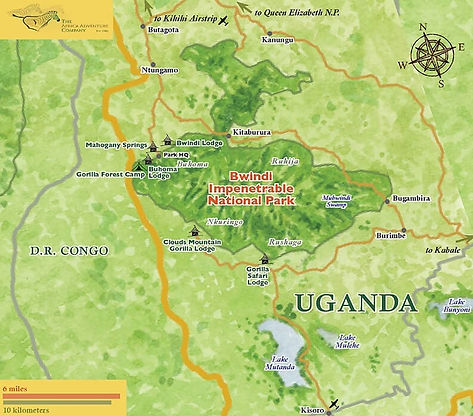
1) Kigali city tour then to Bwindi with views of the volcanoes. Hotel north of Kitoro, by Lake Muche.
2) Bwindi Impenetrable Forest - Gorillas - short hike for oldies. In pm Pigmies
3)To Queen Elizabeth NP - Ishasha sector. Game drive in evening - Targets: Pangolin, Aardvark, Leopard, Views of the rift valley. Hotel near Katura Lodge.
4) Game drive (Modify to Kyambura gorge for primates) and boat ride Kazinga Channel in am , pm to Kibali. Targets: black-and-white colobus monkeys, red-tailed monkeys, birds in Kazinga. Look for Rock Hyrax
Mbasas reserve on way north. Hotel north of Fort Portal
5) Chimps in am, Bigodi on the way pm to Entebbe
Entebbe - Boat trip to boat tour to see Shoebill Stork. - mabambatours.com $180 pp
GYG Entebbe: Private City Tour with Transfers and Ugandan Rolex, Botanical Gardens
Kampala - Tombs, Owino market
RHS home
Mission Africa 5 day Uganda Wildlife Safari $3700 pp
Mission Africa Safaris seems to be focused on gorilla tours for the elderly. Arrive from Kigali Rwanda instead of Entebbe in Uganda. The driving time and distance from Kigali to Bwindi impenetrable forest is shorter. Driving from Entebbe to Bwindi can take 8 hours or more. From Kigali, it takes only 3 hours to reach Bwindi forest.
https://www.silverbackgorillatours.com/gorilla/gorilla-trekking-for-the-elderly-old-and-disabled
Alternates
Golden Monkeys in Virunga NP.
Jinja (source of nile)
Use Visa card
Travelogue - need location setting videos
Nairobi, Markets, Museum - anthropology
Tropical RF Mantadia Lodge, Lemurs, birds
Antainemavero, Analakely market, Rova of the Queen or Ambohimanga
Mandare river, lemurs, Bobab trees, birds, full moon
Rwanda, Markets
Gorillas & Pygmys
Great rift valley
QE2, primates, aardvark, etc
Chimps
Shoebill Stork - Lake Victoria.
Kampala tour - Tombs, Uganda Museum - native huts
Kenya
Bantu early inhabitants, then Portugese and then British
Madagascar history
First populated by Indonesians, followed by Bantu. It became a French protectorate.
The general conclusion of this study is that Southeast Asian maritime powers built, owned, and operated ocean-going ships of respectable size as early as the first few centuries of the first millennium A.D. Trade in the Indian Ocean at the time of first colonization of Madagascar was dominated by Indonesian ships, probably of Borobudur ship (large outrigger) and K'un-lun po types.[4][5] Over two thousand years, the island has received waves of settlers of diverse origins, primarily Austronesian (Indonesian) and Bantu.[6] Centuries of intermarriages between both groups created the Malagasy people, who are roughly an equal mixture of both groups. They speak Malagasy, an Austronesian language with Bantu, French and Arabic influences.
Madagascar wildlife
Lemurs are primates found only on the African island of Madagascar and some tiny neighboring islands. However, chromosomal and molecular evidence suggest that lemurs are more closely related to each other than to other strepsirrhine primates. Strepsirrhini is a suborder of primates that includes the lemuriform primates, which consist of the lemurs of Madagascar, galagos ("bushbabies") and pottos from Africa, and the lorises from India and southeast Asia. For this to have happened, it is thought that a very small ancestral population came to Madagascar via a single rafting event between 50 and 80 million years ago.[
Lemurs are wet-nosed primates of around 100 existing species. They are endemic to the island of Madagascar. Most existing lemurs are small, have a pointed snout, large eyes, and a long tail. They chiefly live in trees and are active at night. Lemurs share resemblance with other primates, but evolved independently from monkeys and apes. Due to Madagascar's highly seasonal climate, lemur evolution has produced a level of species diversity rivaling that of any other primate group. Living lemurs range in weight from the 30-gram (1.1 oz) mouse lemur to the 9-kilogram (20 lb) indri.
Ring tailed lemurs are limited to the south of the island. Indrids dominate in the tropical east.
The indri also called the babakoto,[8] is one of the largest living lemurs, with a head-body length of about 64–72 cm (25–28+1⁄2 in) and a weight of between 6 and 9.5 kg (13 and 21 lb). It has a black and white coat and maintains an upright posture when climbing or clinging. It is monogamous and lives in small family groups, moving through the canopy, and is herbivorous, feeding mainly on leaves but also seeds, fruits, and flowers. The groups are quite vocal, communicating with other groups by singing, roaring and other vocalisations. Besides humans, it is the only mammal found that can use rhythm.
Sifakas are medium-sized indriids with a head and body length of 40 to 55 cm (16 to 22 in) and a weight of 3 to 6 kg (6.6 to 13.2 lb). Their tail is just as long as their body, which differentiates them from the Indri. Their fur is long and silky, with coloration varying by species from yellowish-white to blackish-brown. Their round, hairless face is always black. As with all lemurs, the sifaka has special adaptations for grooming, including a toilet-claw on its second toe and a toothcomb. They are medium- to large-sized lemurs, with only four teeth in the toothcomb instead of the usual six.
Sifakas move by vertical clinging and leaping, meaning they maintain an upright position leaping from tree trunk to tree trunk and moving along branches. They are skillful climbers and powerful jumpers, able to make leaps up to 10 m (32.8 ft) from one tree to the next. On the ground, they move like all indrids, with bipedal, sideways hopping movements of the hind legs, holding their fore limbs up for balance, Verreaux’s Sifaka are particularly famous example. Sifakas are diurnal and arboreal. Sifakas are herbivores, eating leaves, flowers, and fruits. When not searching for food, they spend a good part of the day sunbathing, stretched on the branches. Sifakas live in larger groups than the other indrids (up to 13 animals). They have a firm territory, which they mark with scent glands. Edges of different sifaka territories can overlap. Though they defend their territory from invasion by others of their species, they may peacefully co-exist with other lemur species such as the red-bellied lemur and the common brown lemur.
The fossa is a slender, long-tailed, cat-like mammal that is endemic to Madagascar. It is a member of the carnivoran family Eupleridae.
The fossa is the largest mammalian carnivore on Madagascar and has been compared to a small cougar, as it has convergently evolved many cat-like features. Adults have a head-body length of 70–80 cm (28–31 in) and weigh between 5.5 and 8.6 kg (12 and 19 lb), with the males larger than the females. It has semi-retractable claws (meaning it can extend but not retract its claws fully) and flexible ankles that allow it to climb up and down trees head-first, and also support jumping from tree to tree.
Primarily hard old Metamorphic rock hence its survival as an island. Split from India around 200 Mya, slowly migrated towards Africa. Had to be populated by vegetation rafts, before S. America primates.
East Africa History
Originally Bantu, was subject to Arab and British invasions.
The African Great Lakes kingdoms refers to the numerous historic kingdoms in the African Great Lakes region extending from Lake Victoria south along the Great Rift Valley to Victoria Falls. These polities existed sometime between the eleventh and nineteenth centuries as independent kingdoms, and had similar and yet sometimes distinct cultures, values and traditions. The Great Lakes kingdoms were found in Southeast Africa and some parts of Central Africa, in what is present-day northwest Tanzania, south Uganda, some parts of Rwanda, Burundi and Eastern Congo.
Primarily Bantu peoples in a very fertile valley supporting pastoral lifestyle. Evidence of Iron smelting to form steel from 2000 years ago, well before Europe. Bantu languages derive from the Proto-Bantu reconstructed language, estimated to have been spoken about 4,000 to 3,000 years ago in the area of modern-day Cameroon. They were supposedly spread across Central, East and Southern Africa in the so-called Bantu expansion, comparatively rapid dissemination taking roughly two millennia and dozens of human generations during the 1st millennium BCE and the 1st millennium CE.
The Uganda Museum is the oldest museum in East Africa, cultural village is worth seeing.
East Africa Wildlife
UGANDA
Bwindi Impenetrable Forest for Gorillas It is important to note that among the gorilla trekking national parks, Bwindi is the most ideal for the elderly. Why? Because it is situated in less mountainous areas. Bwindi Impenetrable National Park is not part of the Virunga ranges of mountains like the other three national parks. It sits on lower altitude and the trails are relatively flat compared to Mgahinga and the Volcanoes National Park.
The best time of the year when you should go for gorilla trekking in Uganda is June, July, August and September. If that is not possible, January and February should be relatively okay.
Queen Elizabeth NP - Tree camping lions as well as the usual savannah wildlife. Unusual primates include; black and white colobus monkeys, L’Hoest’s monkeys, red tailed monkeys, blue monkeys, mona monkeys, bush babies and the grey checked mangabeys. Most especially in Kyambura gorge in dry season June to July. Located on Kyambura escarpment near Kyambura trading centre in Queen Elizabeth national Park, the over 16 kilometer long Kyambura Gorge is part of the Western Rift Valley in Uganda the sprawling savannah continues as before. Also Aardvark, Porcupine, topi, waterbuck, Kobi,
Kibale National Park has easy access to chimp families. There are 13 species of primates in Kibale National Park. The park protects several well-studied habituated communities of common chimpanzee, as well as several species of Central African monkey including the Uganda mangabey (Lophocebus ugandae), the Ugandan red colobus (Procolobus tephrosceles) and the L'Hoest's monkey. Other primates that are found in the park include the black-and-white colobus (Colobus guereza) and the blue monkey. The footage of the so-called Ngogo chimps, which live in a remote region of Uganda's comes from an upcoming Netflix documentary series Chimp Empire. It premieres on April 19, 2023.
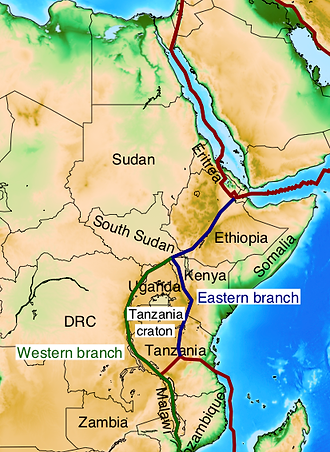
Great rift Valley The Somali plate forms the Eastern edge of Africa. It is moving further east opening up 2 valleys ringed by volcanoes. The Tanzania Craton is an island of Archean 3B ya rock between fault lines. It includes Lake Victoria the source of the Nile river. A superplume exists beneath the craton. Mt Kilimingaro, Serengeti and Ngorogoro Crater, Olduvai Gorge (Leakey fossils) all sit on East branch of the fault. The western branch is the Great Rift Valley. The western mountainous side of GRV is in the Congo. On the East, there is Rwanda in the South and Uganda in the North. In the GRV there are a series of ribbon lakes, notably Lake Tanganika. The Gorillas live in the mountains either side of the Western fault, most notably in the Volcanoes NP at the border between Uganda, Rwanda and Congo These Virunga Mts are part of the West branch of the fault. Queen Elizabeth NP is on the edge of Lake Edward.
Around 100 Mya, the Red Sea was formed as the first part of the Great Rift Valley was formed. This was followed by uplift forming the Ethiopian Mts.. The GRV East fault began pulling apart about 45 million years ago. The necking is estimated to have begun about 4 million years ago as a result of widespread volcanic eruptions. When necking breaks through a new expanding ocean crust is formed. The south end of the east fault is anchored by Kilimanjaro. The GRV extends all the way to Petra and the Jordan Valley.
RWANDA
Nyungwe Forest NP - very diverse inc. chimps and colobus monkey, accessible forest 5 hrs from Kigali. contains Mt Karonje.
Volcanoes NP for mountain gorillas and golden monkeys.
TANZANIA
Gombe Stream National Park - Jane Goodall chimps
GABON
Lope National Park Gabon is one of the only parks in Africa where you can see the Mandrills. No other park in Central Africa is considered more vital for primates than Lopé National Park, the oldest and one of the most astounding biospheres on the African continent. Lope National Park Gabon is home to over 1400 endangered mandrills as well as 420 bird species, the national park is equally a stronghold for western gorillas, sun-tailed guenon, black colobus,